
Peptide PEG MGF: Benefits, Research & Safety Guide
Discover the benefits and research interest of peptide PEG MGF, a pegylated form of MGF peptide known for muscle repair signaling and tissue adaptation. Learn about its impact on stability and activity duration, and what factors to consider before exploring peg MGF peptide benefits.
Overview
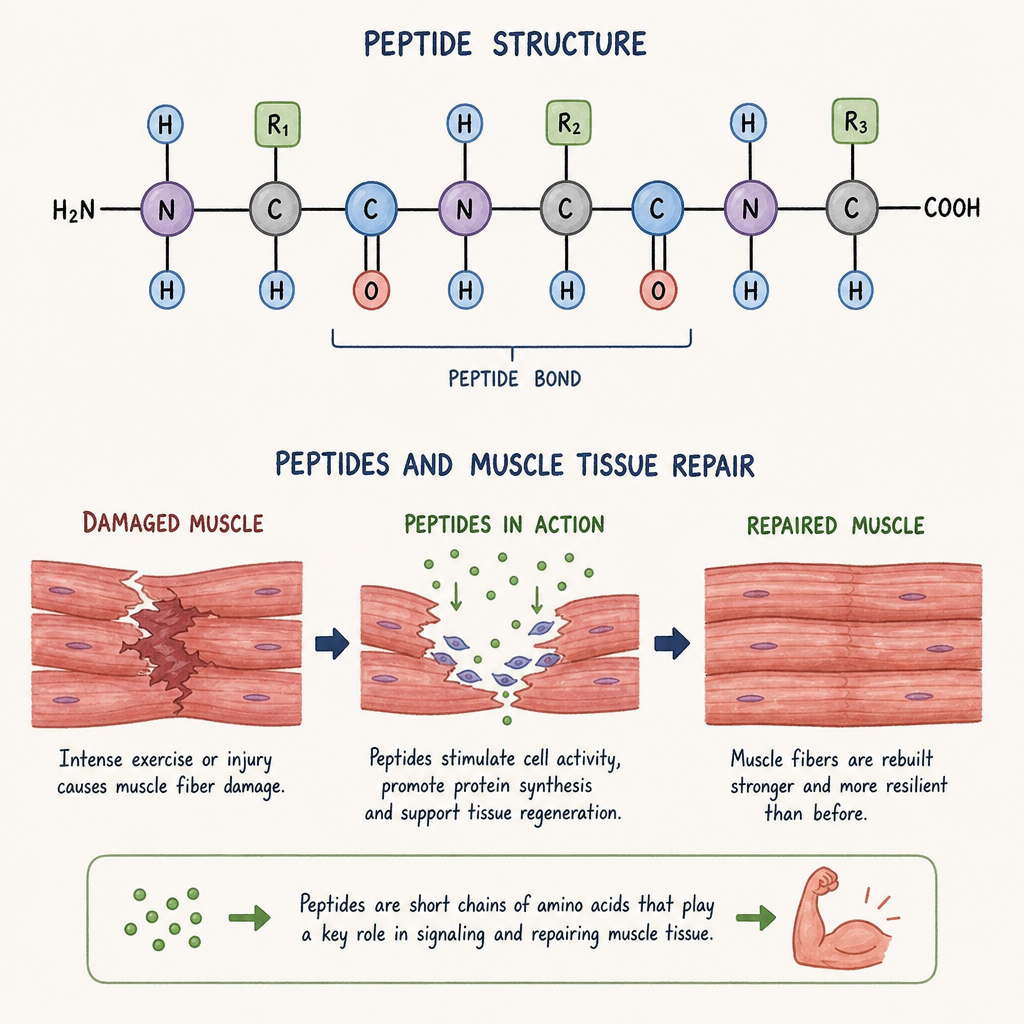
PEG-MGF is a pegylated version of mechano growth factor (MGF), a splice variant of IGF-1 produced in response to muscle damage.
Key Information
Mechanism
Activates satellite cells in damaged muscle tissue, promoting local repair and growth. Pegylation extends half-life from minutes to hours.
Benefits
- Targeted muscle repair
- Satellite cell activation
- Extended half-life (PEG)
- Post-workout recovery
Side Effects
- Minimal reported
- Mild injection site reactions
Contraindications
- Active cancer
Evidence Summary
Studies show enhanced muscle repair and growth, particularly post-exercise.
Research
Studies show enhanced muscle repair and growth, particularly when administered post-exercise.
View ResearchSafety
Generally well-tolerated. Limited long-term human safety data.
Peptide PEG MGF: Benefits, Research & Safety Guide
Peptide PEG MGF is commonly discussed in performance, recovery, and peptide research circles because it is associated with muscle repair signaling and tissue adaptation. In simple terms, PEG MGF refers to a pegylated form of MGF peptide, designed for research interest around stability and activity duration. This article explains what it is, why people talk about it, and what to consider before evaluating any claims about peg mgf peptide benefits or use.
What is Peptide PEG MGF?
Peptide PEG MGF is a modified version of mechano growth factor, often shortened to MGF, which is a splice variant related to insulin-like growth factor signaling. The "PEG" portion refers to pegylation, a process where polyethylene glycol is attached to a molecule to influence how it behaves in a research setting. Because of this modification, pegylated MGF is often discussed as a longer-acting variation compared with non-pegylated MGF peptide.
MGF is generally associated with the body's response to mechanical stress, such as resistance training or tissue strain. In educational and research conversations, it is often linked to repair pathways, satellite cell activity, and muscle adaptation. However, it is important to separate broad biological theory from proven outcomes in humans, especially when claims become specific or promotional.
The Role of Pegylation in Peptide Design
Pegylation is used in peptide and protein development to alter certain properties of a compound. In practical terms, the goal is often to make a molecule more stable or less rapidly cleared in controlled research environments. That is why the phrase peg mgf appears frequently in discussions about extended activity compared with shorter-lived peptide forms.
For readers new to the topic, this does not mean pegylated MGF is automatically safer, more effective, or appropriate for personal use. It simply means the molecule has been modified in a way that may change its duration, solubility, or handling characteristics. Those details matter because peptide behavior can vary significantly depending on formulation, purity, storage, and context.
Why Are People Interested in Peg MGF Peptide Benefits?
People are interested in peg MGF peptide benefits because MGF is associated with repair and adaptation signals that become relevant after mechanical stress. In theory, this makes the peg mgf peptide appealing to researchers studying muscle recovery, tissue response, and cellular repair pathways. The interest is strongest where the goal is to understand how growth-related signaling may influence adaptation after strain or injury.
Commonly discussed areas include:
- Muscle recovery research: MGF is often connected with post-exercise repair signaling, making it a frequent topic in discussions around resistance training adaptation.
- Satellite cell activity: Some conversations focus on how MGF-related pathways may support cells involved in muscle maintenance and repair.
- Tissue response models: Researchers may examine how growth-factor-related compounds interact with stressed or damaged tissue environments.
- Peptide stability: The pegylated format is often discussed because stability and duration are practical concerns in peptide research.
The key word here is "research." Benefits described online are often extrapolated from early findings, animal models, or theoretical mechanisms. A careful reader should treat dramatic claims with caution and look for human evidence, transparent sourcing, and responsible language.
Common Research-Focused Uses and Discussion Areas
Most conversations about peptide peg mgf fall into a few broad categories. These categories are useful for understanding the topic, but they should not be read as medical recommendations or guaranteed outcomes.
Muscle Adaptation and Repair Signaling
The most common area of discussion is muscle tissue response after mechanical loading. Because MGF is linked with repair-related signaling, it is often mentioned in the same context as training stress, recovery windows, and tissue remodeling. The pegylated version attracts attention because researchers may be interested in whether a longer activity profile changes observed effects.
For readers, the practical takeaway is simple: this compound is not a substitute for training quality, nutrition, sleep, or injury management. Even if a molecule is being studied for repair signaling, real-world recovery is influenced by many factors. Overlooking those basics can lead to unrealistic expectations.
Injury and Tissue Stress Models
Another discussion area involves tissue damage or strain models. In this context, MGF peptide may be explored for how it interacts with repair environments. The focus is usually on cellular behavior rather than broad wellness claims.
This distinction matters. A compound being studied in a controlled model does not mean it has established clinical use for injuries. Anyone dealing with pain, limited mobility, or suspected tissue damage should seek qualified medical evaluation rather than relying on peptide information online.
Longevity and Performance Conversations
Peg mgf also appears in broader performance and longevity discussions. These conversations can be especially mixed in quality. Some are educational and cautious, while others overstate what is known.
A practical approach is to ask what kind of evidence supports each claim. Is the source explaining mechanisms, or promising results? Is it clear about limitations? Does it distinguish between research use and approved medical use? Those questions help keep expectations grounded.
Responsible Evaluation Matters
Interest in peg mgf peptide benefits should be balanced with a careful look at evidence, safety, and product quality. Peptides can be sensitive compounds, and poor handling or unclear sourcing can create additional risk. Even educational content should avoid treating them like ordinary supplements.
Before trusting any claim about peptide PEG MGF, consider the following checklist:
- Evidence quality: Look for clear references to research rather than vague promises.
- Claim strength: Be cautious when a source guarantees muscle growth, healing, fat loss, or rapid recovery.
- Use context: Check whether the discussion is about laboratory research, animal studies, clinical medicine, or personal experimentation.
- Product transparency: Responsible suppliers usually provide basic details such as identity, purity testing, batch information, and storage guidance.
- Health context: Medical history, medications, endocrine health, injuries, and training load can all change risk.
- Professional guidance: Questions involving health, dosing, injections, or injury recovery should be discussed with a qualified clinician.
What Should You Know About Peg MGF Peptide Dosage?
Peg MGF peptide dosage is a topic that should be approached carefully because dosing depends on legal status, research context, compound quality, individual health factors, and intended use. Public dosage claims are often inconsistent, and copying protocols from forums or product pages can be risky. For that reason, this article does not provide dosing instructions or suggest a personal-use protocol.
If dosage is being discussed in a legitimate research setting, it should be defined by an approved protocol, appropriate oversight, and accurate measurement. If dosage is being discussed for personal use, the safest next step is to speak with a licensed healthcare professional who understands peptides, endocrine signaling, and your health history.
A few practical points are still worth understanding:
- More is not automatically better. Growth-factor-related pathways can be complex, and excessive or poorly planned use may increase risk.
- Purity affects reliability. An unknown or contaminated product makes any dosage discussion less meaningful.
- Storage and handling matter. Peptides may degrade if they are stored or reconstituted incorrectly.
- Individual context matters. Body size, training status, injury history, and health conditions can change risk considerations.
Separating Realistic Expectations From Hype
The strongest marketing around pegylated MGF often makes the compound sound simple: take a peptide, recover faster, build more muscle, and move on. Biology is not that neat. Muscle repair and growth involve training stimulus, protein intake, energy availability, sleep quality, inflammation management, hormones, and time.
A more realistic view is that peg mgf is a research-interest peptide connected to mechanisms that may matter in tissue adaptation. That does not make every benefit claim reliable. It also does not make the compound appropriate for everyone, or even necessary for most people seeking better recovery.
For athletes and active adults, the foundation remains familiar but powerful:
- Follow a progressive training plan instead of constantly chasing fatigue.
- Eat enough protein and total calories to support repair.
- Prioritize sleep, especially during high-volume training blocks.
- Manage injuries early rather than training through worsening pain.
- Use lab testing and clinical guidance when exploring hormone- or peptide-related options.
These basics may sound less exciting than a new compound, but they are usually the highest-value place to start.

Quality, Legality, and Safety Considerations
Peptides are not all produced, labeled, or tested to the same standard. This makes quality control one of the most important issues in any discussion of peptide peg mgf. A label alone does not confirm identity, purity, concentration, sterility, or proper handling.
Legality and permitted use can also vary by location and context. A compound may be sold for research purposes but not approved for human use, or it may be restricted in competitive sports. If a reader is subject to drug testing or professional rules, they should verify the relevant regulations through official channels before considering any peptide-related product.
Safety considerations should include more than immediate side effects. Growth-factor-related signaling can interact with complex biological systems, and long-term implications may not be fully defined for many research peptides. That uncertainty is a reason to be cautious, not casual.
Key Takeaways
Peptide PEG MGF is a pegylated form of MGF peptide that attracts attention because of its connection to muscle repair signaling and the potential stability advantages associated with pegylation. It is most responsibly discussed in a research and educational context, not as a guaranteed shortcut for recovery or muscle growth.
The most important takeaways are:
- Pegylated MGF is discussed for its relationship to repair and adaptation pathways.
- The PEG modification may influence stability and duration in research contexts.
- Benefits are often theoretical, early-stage, or dependent on context.
- Peg MGF peptide dosage should not be copied from unverified online sources.
- Product quality, legality, health status, and professional oversight matter.
- Recovery fundamentals still play the biggest practical role for most people.
Used as a learning topic, peg mgf can help readers understand how peptide research intersects with muscle biology. Used casually or without guidance, it can create unnecessary risk. The smartest approach is to stay curious, stay critical, and treat any health-related decision as something that deserves qualified professional input.
Related Muscle Growth Peptides
Key Research Papers on Peptide PEG MGF: Benefits, Research & Safety Guide
The following peer-reviewed studies and clinical trials are indexed in our research library for Peptide PEG MGF: Benefits, Research & Safety Guide. Each paper links to a detailed summary with key findings, study design, and publication metadata.
- Gene expression in response to muscle stretch — Clin Orthop Relat Res, 2002 (480 citations)
- Mechano-growth factor peptide, the COOH terminus of unprocessed insulin-like growth factor 1, has no apparent effect on myoblasts or primary muscle stem cells — Am J Physiol Endocrinol Metab, 2014 (240 citations)
- The role of mechano-growth factor E peptide in the regulation of osteosarcoma — Oncol Lett, 2015 (220 citations)
- MGF E peptide improves anterior cruciate ligament repair by inhibiting hypoxia-induced cell apoptosis and accelerating angiogenesis — J Cell Physiol, 2019 (140 citations)
- The emerging landscape of performance-enhancing peptides modulating GH-IGF1 axis: bridging the gap between clinical evidence and patient self-administration — Front Endocrinol (Lausanne), 2026 (10 citations)
Related Muscle growth / Anabolic Peptides
Other peptides in the muscle growth / anabolic category that may be of interest for comparative research:
No vendor prices yet
We don't have pricing data for this peptide yet.
Write a Review
Login to write a review
You need an account to share your experience with Peptide PEG MGF: Benefits, Research & Safety Guide.
Sign UpRating Breakdown
Based on 33 reviews.
Reviews
I'm 31, work real estate, and train 4x/week. Ran PEG-MGF at 200 mcg subQ twice weekly, post-lower-body days, for 6 weeks. Stuck to protein and sleep. Noticed fuller quads and shoulders by week 3. Added about 4 lbs lean mass on scale, lost maybe 1% body fat. Squat went from 155x5 to 175x5, and soreness after leg day dropped enough to show houses without limping. Side effects: mild injection-site red bumps for a day, a couple headaches the first week. No crazy water bloat. Pricey, but I'd reorder. Pinning less often is the main win.
I’m a 45-year-old PT and started PEG-MGF at 200 mcg subQ twice a week for 8 weeks. I kept lifting and working, nothing crazy. By week 3 my post-leg-day soreness dropped from 3 days to about 1.5, and my leg press went from 185x8 to 215x8. Shoulder rehab felt smoother too. Side effects were minor: red bump at injection sites for a day, and a little tired the first few doses. I didn’t see huge size, maybe a bit fuller in quads. I’d use it again for recovery, but it’s pricey for subtle gains.
I'm 45 and an accountant, so desk job plus gym 4x a week. Ran PEG-MGF at 300mcg post-workout, 3 days a week for 6 weeks. Noticed my recovery between sessions improved a lot—less soreness in my shoulders and knees. Added about 5lbs to my bench and 10lbs to squat, but that could be from just training harder. Arms maybe 1/4 inch bigger. Side effects: slight redness at injection site and a couple headaches. Nothing major. Not cheap, but for a guy my age trying to keep up, it was worth it.
I'm a 30-year-old landscaper and started PEG-MGF at 200 mcg twice a week, post-workout, for 6 weeks. By week 3 my legs felt less wrecked after digging and hauling sod. Squat went from 135x5 to 150x5, and my shoulders recovered faster between planting days. No huge size jump, maybe 1/4 inch on arms, but I looked fuller. Side effects were minor: red bump at injection site for a day, slight headache first two pins, and a bit of water weight. Would buy again for recovery.
36 y/o female paramedic, lifting 4x/week. Ran PEG-MGF at 200 mcg subQ 3x/week for 6 weeks, post-lift. Recovery came first: hit 8x3 back squat at 185 lb without the usual day-3 ache, and DOMS dropped maybe 40%. Added 5-7 lb lean mass per InBody, arms and calves fuller. Strength up around 10 lb on bench and trap bar. Sleep fine, no injection site issues, just mild watery eyes for the first hour after pins. Not a miracle, appetite was up. Long half-life means 3x/week was plenty. Would run again as a bridge.
I'm 36, a graphic designer, and I lift 4x/week. Ran PEG-MGF at 200 mcg subQ post-lift, 3x/week for 6 weeks. First two weeks nothing obvious. By week 4 my legs weren't wrecked after squats, and I added about 10 lbs to my working sets. Scale went up 2 lbs, probably some water. Injections were easy, but a few left small red welts for a day. Mild headache after the first couple doses. No crazy size, maybe a little fuller in shoulders. Would use again for recovery, but not expect miracles.
41 y/o dev, lifting 4x/week. Ran PEG-MGF at 300 mcg post-workout, 3x/week for 6 weeks. Injection sites got a little red and warm for a day, no big deal. Soreness after heavy squats dropped from 3 days to about 1.5. Added 5 lbs on bench and maybe 1/4 inch to arms, nothing crazy. Strength gains were modest, but recovery and joint feel were the wins. Half-life seemed way better than plain MGF. Would buy again if price stays sane.
I ran PEG-MGF at 300 mcg subQ three times a week for six weeks, mostly after heavy leg days. I'm a 38-year-old lab tech, so I'm on my feet a lot. Soreness after squats dropped from about three days to one, and my knees felt less cranky. I added maybe 10 lbs to my squat and 5 lbs to bench, but actual size change was modest—maybe 1/4 inch on my arms. Side effects: mild redness at injection sites and a sleepy, almost flu-like feeling for a few hours after pinning. No crazy water weight. I'd use it again for recovery, not for huge gains.
31-year-old chef on my feet 10-12 hrs. Ran PEG-MGF at 200 mcg post-workout, 5 days on/2 off, for 6 weeks. Subq near the trained muscle. Recovery was the standout: heavy squat soreness went from 3 days to about 1.5. Added maybe 10 lbs on squat and 5 lbs on bench, but scale only up 2 lbs — more fullness than raw mass. Slight water retention and occasional injection-site itch for a day. Sleep fine. PEG version seems to last, no extra pins needed. Not magic, but worth it if you train hard and need to bounce back.
I’m 31 and drive a semi, so my schedule is rough. Ran PEG-MGF at 300 mcg subq post-workout, 3x a week for 6 weeks. Kept calories steady. By week 3 my legs stopped feeling trashed after squat/deadlift days. Ended up adding 25 lbs to my squat and about 4 lbs on the scale, likely some water. Recovery between stops felt faster, but I got mild lethargy for a day after pins and a couple red lumps at injection sites. Nothing major. Half-life seemed long enough that I didn’t need daily shots. Price was fair for the results.
I’m 55, run a busy kitchen, and lifting is my stress relief. Ran PEG-MGF at 200 mcg subQ after training, 3 days a week for 6 weeks. First two weeks I got a little sleepy post-pin and a red bump at the site, but no worse. By week 4 my knees and shoulders felt less beat up between shifts, and I could train legs twice a week again. Added about 5 lbs on the scale, bench went from 205 to 220, squat 275 to 295. Nothing dramatic visually, but recovery and gym consistency were much better. Pricey, so not a forever thing.
45, graphic designer, desk job but I've lifted for years. Ran PEG-MGF at 200mcg post-workout, three times weekly for six weeks, IM into the biceps and triceps. Arms got noticeably fuller, cold measurement up about 0.4in on the left, 0.3 on the right. Soreness cleared in a day instead of two, so I could hit arms again sooner. Close-grip bench went up maybe 10lbs, nothing crazy. Side effects: red welts and small lumps at the pin sites for a day or two, and I felt flat and lethargic during week four. Long half-life, so I never dosed on off days. Would run again, maybe lower dose.
I'm 34 and work a desk job, so gym time is limited. Tried PEG-MGF at 250 mcg post-workout, twice weekly for 6 weeks. Recovery was the standout—soreness dropped from 3 days to about 1. Leg day no longer wrecked me. Added 5 lbs to my bench and put on roughly 3 lbs lean mass. Sides were just some redness at injection spots that faded in a day. Not a huge mass builder, but for the price and convenience, it's a decent addition. Will likely run it again.
I’m 52, teach high school, and lifting is my sanity. Ran PEG-MGF at 200 mcg subq 3x/week for 6 weeks, mostly on leg and back days. By week 3 my knees didn’t ache as much after squats, and I was adding 10-15 lbs on my top sets. Arms maybe 1/4 inch, so not huge, but fuller. Injection sites got red and itchy for a day, and one mild headache after dosing too late. Sleep was normal. It’s not cheap, but I kept my routine and felt better. Would use again at a lower dose.
Ran PEG-MGF at 300 mcg subq 3x/week for 6 weeks, usually after legs. I'm 55, desk job, lifting 4 days. First 2 weeks not much besides some redness at pin sites and a little tired the next morning. By week 4 my squats went from 185x5 to 205x5 and recovery between sets felt quicker. No magic size jump—maybe a quarter inch on arms—but my old tendinitis in the elbows was way less angry. Dropped it because vials aren't cheap. Sleep was fine, no weird heart stuff. Probably won't blow you up, but for recovery it did its job.
Used PEG-MGF at 300 mcg subq three times a week after heavy lifting, ran it six weeks. I’m 43, work as a PT, so recovery matters more than ego. First two weeks nothing dramatic, then my elbow tendonitis calmed down and I could handle two extra clinic days without crashing. Squat went from 275x5 to 300x5, bodyweight up about 3 lbs with visible upper-chest fullness. No real PIP, just a little red bump that faded in a day. Some nights I felt a bit tired after pinning, nothing crazy. Would buy again if price was right.
Ran PEG-MGF at 300 mcg subq twice weekly for six weeks, usually after heavy lower-body days. I'm 36, desk job, lifting four times a week. By week 3, recovery felt faster—squat soreness dropped from about 3 days to 1.5. Added roughly 4 lbs while waist stayed the same. Bench went from 225x5 to 235x5; squat 315x3 to 330x3. Injection sites got red and itchy for a day, and the first two pins made me sleepy for an hour. No wild size jump, but steady. Only two pins weekly, so the PEG version clearly hangs around longer. Not cheap, but I'd run it again.
Ran PEG-MGF for 6 weeks at 200mcg post-workout, 5 days on, 2 off. I'm 28, used to turn wrenches before a back injury, so recovery matters. First two weeks not much, maybe better sleep. By week 4 my squat went from 275 to 295 and I put on about 3-4 lbs while eating normal. Recovery between leg days felt faster, less soreness. The PEG version lasted longer between pins. Side effects: red lump at injection sites for a day, mild headache first week, some lethargy after pins. No crazy mass but steady. Would use again if price was right.
Lifting off and on for years, but after 40 my legs quit growing no matter what. I ran PEG-MGF at 200mcg subQ immediately after training, four days a week, for six weeks straight. Around week three my quads felt denser and I could hit two heavy leg days without that dragging three-day soreness. Squat went from 135 to 155 for reps, and my jeans fit differently. Downsides: small red lumps at the pin sites that faded within a day, plus about an hour of foggy tiredness after each shot. No bloat, no mood swings. Cost is steep, but I'd order again.
52-year-old stay-at-home dad here. Ran PEG-MGF at 200 mcg subQ twice a week for 6 weeks, usually after leg day. Not a miracle, but recovery was noticeably better by week 3. I could do school pickup and still hit squats without feeling wrecked. Added maybe 2-3 lbs lean mass and leg press went up 20 lbs. Sleep was deeper. Side effects: mild redness at injection sites and a couple headaches first week. No crazy water retention. The PEG version seems to last longer, so twice weekly was enough for me. I'll run it again.
41-year-old software dev here. Ran PEG-MGF at 300 mcg subQ twice a week for 6 weeks while lifting 4x/week. Recovery was the main thing - leg soreness went from 3 days to about 1.5. Added 5 lbs to my squat and 10 lbs to bench, plus 2-3 lbs on scale, likely some water. No real pip, just slight redness twice. Sleep felt a bit deeper. No mood crashes. Not a mass builder, but I'll run it again for a lean bulk.
43yo PT here. Ran PEG-MGF at 250mcg daily for 4 weeks, subq into my torn rotator cuff area. Noticed less pain within 10 days, and by week 3 I could do overhead presses again. Gained about 5lbs lean mass, but diet was on point. Strength up maybe 15lbs on bench. Only side effect was occasional redness at injection site. Half-life seems long, no need for multiple pins. Not cheap, but for injury healing it's worth it. Would recommend for older guys with nagging issues.
I’m 43, work as a physical therapist, and lift 4x/week. Ran PEG-MGF at 400 mcg subQ post-workout, 3 days/week for 6 weeks. Injection sites got red and itchy for a day, and I was a bit tired the first week. Recovery was the clear win: squat DOMS went from 3 days to about 1.5, and my elbow tendinopathy calmed down enough to press pain-free. Strength went up modestly—bench +15 lbs, but I also trained harder. Maybe 2-3 lbs lean mass. No BP or sleep issues. Not cheap, but useful if you’re rehabbing and pushing volume.
I'm 28, nurse, lifting 4x/week. Ran PEG-MGF at 200mcg post-workout 3x/week for 6 weeks, injected subq near bi's/tri's. Noticed fuller arms by week 3, maybe 0.4 inch on cold flexed bicep. Recovery was the bigger win—less soreness after heavy pull days, could add a back session without dying. Strength went up ~10 lbs on weighted dips. Sides: mild injection site redness and a couple nights of feeling a bit tired. No crazy pumps or size jump. Good tool if recovery is your bottleneck, but pricey.
Been running PEG-MGF for 8 weeks, 200 mcg subQ post-workout 3x/week. I'm 55, still on my feet 10 hrs in a kitchen. Noticed calves and forearms thicker, maybe 1/4 inch, and squats went from 185x5 to 205x5. Recovery between double shifts is better, less ache. First few pins had mild redness and a bit of lethargy for an hour. No bloodwork issues at 8 weeks. It's not magic, but for the price and safety it's worth it if you train consistently.
35F, run a small landscaping crew. Ran PEG-MGF at 300 mcg subq 3x/week for 6 weeks, mornings before big install days. First two weeks nothing obvious. By week 3 my post-dig soreness dropped from about 3 days to 1.5, and I could do 8-10 more wheelbarrow loads before grip failed. Added maybe 4-5 lb lean scale weight while eating normal. No real strength PRs, but endurance in shoulders/back better. Side effects: mild injection-site redness that faded in a day, a few nights of restless sleep. Would buy again for recovery, not a mass builder.
I'm 34, on my feet all day for sales, so my legs and back were always sore. Tried PEG-MGF at 200mcg per shot, 3x a week for 5 weeks. By week 3, my post-leg day soreness cut from 3 days to about 1.5. I could add 10 lbs to my squat for reps. No crazy muscle growth, maybe a little fuller. Injection site stung for a few minutes. No other sides. Worth it for recovery, but don't expect magic. Would use again if I had a big event coming up.
I’m 38, work as a nurse, so I’m kinda picky about paperwork. I grabbed some peg-mgf as lab reference material, first time with this one. It showed up in a few days and the batch COA was included, which I didn’t expect tbh. I asked a couple questions about the documentation and got answers pretty fast, they even told me which outside lab ran the analysis. That’s honestly the part I care about. I’m only writing about the docs/service side here, no results, no amount, and I’m not saying anyone should use it. Just my two cents from a lab-reference order.
51yo vet tech, lifting 4x/week. Ran PEG-MGF at 300 mcg subq twice weekly for 6 weeks. Noticed faster recovery after heavy squats by week 2—less DOMS, could train legs twice a week instead of once. Added about 4 lbs on scale while calories stayed same, and my bench went from 205 to 215. Injection sites got red and itchy a few times, and I had some mild water bloat first 10 days. No crazy pumps. It's subtle, not magic, but for an older guy it helped me hang onto mass and bounce back. Would use again, though price is steep.
I'm 35, work as a vet tech so lots of lifting animals. Tried PEG-MGF at 200mcg daily for 4 weeks. Noticed my left elbow tendonitis improved by maybe 50% after week two. Muscle fullness in my arms? Slight, maybe 1/4 inch on cold flexed bicep. No strength jump, but recovery between shifts felt easier. Side effects: mild injection site redness that faded in a day, and a bit of lethargy first few days. Didn't get the huge pumps some claim. For the price, it's okay but not amazing. Would use again for recovery.
34, realtor, always on my feet. Ran PEG-MGF at 200 mcg post-workout, 5x/week for 6 weeks. Mixed it with BAC water, pinned subq in love handle. First two weeks not much, then recovery got silly—leg day soreness gone in a day instead of three. Added about 7 lbs on scale while staying same waist, squat went from 315x5 to 345x5. No crazy pumps, but fuller. Sides: minor red welt at injection site and a little tired first few days. No flu, no appetite crash. Would use again, though price stung. It's not magic, but for recovery and steady size it did what I wanted.
I'm 52, work 10-hour shifts on concrete. Started PEG-MGF at 300 mcg, two shots a week, for 6 weeks. By week 3 my shoulders didn't burn after lifting boxes. I added about 15 lbs to my squat and my recovery between sets felt faster. Injection site got a little red and itchy for a day, nothing bad. No crazy muscle growth, but my arms look a bit fuller. For the price, it's worth it if you're beat up like me.
I’m 45 and wrench on cars all day, so my joints and muscles are usually wrecked. I ran PEG-MGF after workouts for a while. Not gonna lie, recovery felt better. From what I understand it helps activate satelite cells so muscle damage gets repaired faster. The PEG thing makes it hang around longer too. It ain’t as strong as IGF-LR3 for actual growth, imo, but for recovery it worked better for me. Didn’t really notice any sides. Tbh I’d use it again when I’m beat up from work and training.
Community Discussions on PEG MGF
Join the conversation in our peptide community forum. Real users share their peg mgf experiences, dosing schedules, results, and tips.
Visit the community forum